Temporaryfileuploadhandler Verify That File Is Uploaded Python
One of the absurd things about building web applications is the ability to either upload or download files from the web app.
In this tutorial we will be exploring streamlit file upload characteristic. With this feature yous can upload any type of files and use them in your app. To work with the file uploads you will have to use the st.file_uploader() office.
Let us run across how the st.file_uploader() functions works.
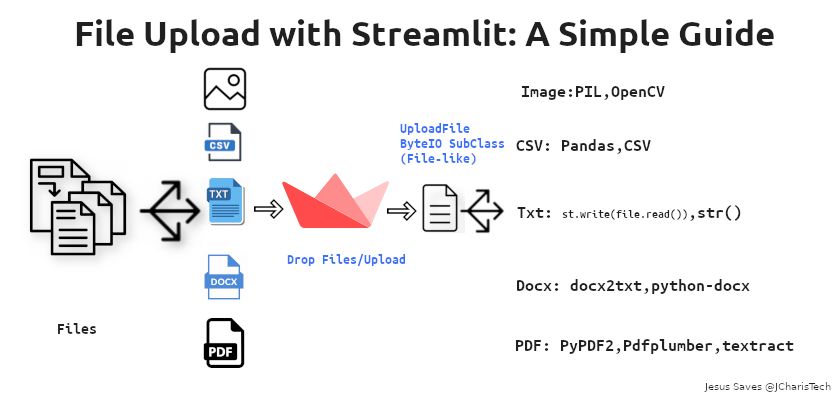
First of all allow united states of america explore the various features of the st.file_uploader()
- Ability to specify the blazon of file you want to let(type=[]): This feature is quite useful every bit it gives you a form of security out of the box with little code. Hence unspecified file types are disallowed and restricted when the user uploads a file.
- Ability to receive multiple files: (accept_multiple_files=True): With this feature you can accept multiple file likewise equally fifty-fifty select multiple files and upload them.
- Ability to specify the limit of files to upload : By default the maximum limit is 200mb but Streamlit allows you lot to change the limit.
These are the commonest features out of the box but there are some other nice features that needs explanation.
Let united states of america come across how the file_uploader() works.
The UploadedFile Class
Whatever file uploaded will be seen nether the UploadedFile Class which in this context is a bracket of ByteIO . This is 'file-like ' so in case you are working with it – you are to treat it similar how you volition treat a file. Therefore yous will have to use the correct file processing library or package to process or read your uploaded file.
Hence if it is an paradigm you will have to use PIL or OpenCV ,etc.
Filetype and Their Respective Packages
Image(PNG,JPEG,JPG): PIL,OpenCV,Scikit-Image
CSV: Pandas, DataTable,CSV
PDF: pyPDF2,pdfplumber,etc
Docx: Docx2Txt,python-docx,textract,
Getting the FIlename and Filesize
With the UploadedFile Class you can get the original filename, filesize and filetype. Doing a dir(uploaded_file) will show all the attributes and methods of this class. Hence you tin can become the original details.
For the original filename,filesize and filetype you can employ the code below
uploaded_file = st.file_uploader("Upload Files",type=['png','jpeg']) if uploaded_file is not None: file_details = {"FileName":uploaded_file.name,"FileType":uploaded_file.type,"FileSize":uploaded_file.size} st.write(file_details) This is the aforementioned thing that shows just below the elevate and driblet section when you upload a file.
Reading Each File Type
To make information technology easy I have built a unproblematic file_upload app and you can check the code below
import streamlit as st import streamlit.components.v1 equally stc # File Processing Pkgs import pandas equally pd import docx2txt from PIL import Image from PyPDF2 import PdfFileReader import pdfplumber def read_pdf(file): pdfReader = PdfFileReader(file) count = pdfReader.numPages all_page_text = "" for i in range(count): page = pdfReader.getPage(i) all_page_text += folio.extractText() render all_page_text def read_pdf_with_pdfplumber(file): with pdfplumber.open(file) as pdf: page = pdf.pages[0] render page.extract_text() # import fitz # this is pymupdf # def read_pdf_with_fitz(file): # with fitz.open(file) as md: # text = "" # for page in dr.: # text += page.getText() # render text # Fxn @st.cache def load_image(image_file): img = Image.open(image_file) return img def master(): st.championship("File Upload Tutorial") menu = ["Home","Dataset","DocumentFiles","Nigh"] choice = st.sidebar.selectbox("Menu",menu) if choice == "Dwelling house": st.subheader("Home") image_file = st.file_uploader("Upload Image",type=['png','jpeg','jpg']) if image_file is not None: # To See Details # st.write(blazon(image_file)) # st.write(dir(image_file)) file_details = {"Filename":image_file.name,"FileType":image_file.type,"FileSize":image_file.size} st.write(file_details) img = load_image(image_file) st.image(img,width=250,superlative=250) elif choice == "Dataset": st.subheader("Dataset") data_file = st.file_uploader("Upload CSV",blazon=['csv']) if st.push button("Process"): if data_file is not None: file_details = {"Filename":data_file.proper name,"FileType":data_file.type,"FileSize":data_file.size} st.write(file_details) df = pd.read_csv(data_file) st.dataframe(df) elif choice == "DocumentFiles": st.subheader("DocumentFiles") docx_file = st.file_uploader("Upload File",type=['txt','docx','pdf']) if st.button("Procedure"): if docx_file is not None: file_details = {"Filename":docx_file.proper name,"FileType":docx_file.type,"FileSize":docx_file.size} st.write(file_details) # Cheque File Blazon if docx_file.type == "text/patently": # raw_text = docx_file.read() # read as bytes # st.write(raw_text) # st.text(raw_text) # fails st.text(str(docx_file.read(),"utf-8")) # empty raw_text = str(docx_file.read(),"utf-eight") # works with st.text and st.write,used for futher processing # st.text(raw_text) # Works st.write(raw_text) # works elif docx_file.type == "awarding/pdf": # raw_text = read_pdf(docx_file) # st.write(raw_text) try: with pdfplumber.open(docx_file) equally pdf: page = pdf.pages[0] st.write(page.extract_text()) except: st.write("None") elif docx_file.type == "application/vnd.openxmlformats-officedocument.wordprocessingml.certificate": # Use the correct file processor ( Docx,Docx2Text,etc) raw_text = docx2txt.procedure(docx_file) # Parse in the uploadFile Class directory st.write(raw_text) else: st.subheader("About") st.info("Built with Streamlit") st.info("Jesus Saves @JCharisTech") st.text("Jesse E.Agbe(JCharis)") if __name__ == '__main__': main() You can as well check out the video tutorial below
Thanks For Your Time
Jesus Saves
By Jesse Due east.Agbe(JCharis)
Source: https://blog.jcharistech.com/2020/11/08/working-with-file-uploads-in-streamlit-python/
0 Response to "Temporaryfileuploadhandler Verify That File Is Uploaded Python"
Post a Comment